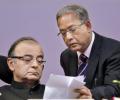
Sebi will be taking a number of measures to develop a derivatives market of commodities.

From the Sensex pack, State Bank of India, Axis Bank, IndusInd Bank, Tech Mahindra, HCL Technologies, Tata Consultancy Services, Maruti Suzuki, Tata Steel and Tata Motors were the major gainers. Power Grid and HDFC Bank were the laggards from the pack.

Damage from new shenanigans can be contained if regulators move quickly when something does not smell right, counsels Debashis Basu.

The Indian economy is projected to grow at 6.3 per cent in current financial year aided by investment and domestic demand. According to a World Bank report released on Tuesday, India continues to show resilience against the backdrop of a challenging global environment. In India, which accounts for the bulk of South Asia region, growth is expected to remain robust at 6.3 per cent in 2023-24, India Development Update of the World Bank said.

Shares of Infosys hit a five-month low of Rs 1,419.60, down 1 per cent on the BSE in Tuesday's intra-day trade. The stock was quoting at its lowest level since October 10, 2022. In past two days, the stock of information technology (IT) bellwether was down 4 per cent after the company on Saturday informed to the stock exchanges that Mohit Joshi, president of the company has resigned effective March 11, 2023. Mohit Joshi will be on leave thereafter and his last date for the company would be June 9, 2023, Infosys said in an exchange filing.
According to sources, BSE is seeking an offering that would value it at about Rs 4,000-5,000 crore (Rs 40-50 billion).

The surge in volatility across the globe sparked by Russian invasion of Ukraine has led to an increase in prices of gold and silver - considered to be safe-haven investment bets. In the past month, silver funds have delivered returns of 7.34 per cent, while gold funds on an average have risen around 6 per cent. In comparison, the benchmark Nifty has declined 4 per cent. Fund managers say precious commodities act as a good hedge against inflation and phases of geopolitical uncertainty.

Among the Sensex firms, HCL Technologies, Tata Motors, Hindustan Unilever, NTPC, IndusInd Bank, Bajaj Finserv, Bajaj Finance and Mahindra & Mahindra were the major gainers. Bharti Airtel, Reliance Industries, ICICI Bank and Asian Paints were the laggards.

The Ministry of Corporate Affairs ordered the inspection of the books of accounts of NSEL and Financial Technologies India Ltd to ascertain if any rules under the Companies Act were violated, a senior official said.
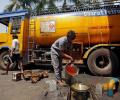
The medium-term scenario for oil marketing companies (OMCs) is high risk due to the surging crude and gas prices. Apart from OPEC-plus cutting production, the Hamas-Israel conflict has caused fears of supply disruption. The July-September quarter of 2023-24 (Q2FY24) saw positive surprises for OMCs. Strong gross refining margins (GRMs) more than offset weak marketing margins.

Investors' wealth eroded by Rs 3.46 lakh crore on Wednesday as equity markets took a sharp tumble amid weak global trends and foreign fund outflows. The 30-share BSE Sensex fell by 676.53 points or 1.02 per cent to settle at 65,782.78. During the day, it plunged 1,027.63 points or 1.54 per cent to 65,431.68. In line with the weak trend in equities, the market capitalisation of BSE-listed firms eroded by Rs 3,46,947.54 crore to Rs 3,03,33,258.69 crore.

Benchmark indices Sensex and Nifty gained around half a per cent to close at nearly five-month high levels on Monday following continuous foreign fund inflows and firm trends in Asian and European markets. Rising for a second straight day, the 30-share BSE Sensex climbed 317.81 points or 0.51 per cent to settle at 62,345.71, the highest closing level since December 14. During the day, it rallied 534.77 points or 0.86 per cent to 62,562.67.

India's foreign exchange reserves declined $1.15 billion to $571.56 billion for the week ended July 22, according to RBI data. The reserves has been declining amid continuing volatility in the rupee which has also significantly depreciated against the US dollar. In the previous reporting week, the overall reserves had declined by $7.54 billion to $572.71 billion.

Deloitte, MCX's is learnt to have objected to PwC pointing out several irregularities in the exchange's expenditure, donations, etc, in its audit report.

The board of directors at its meeting held on October 22, approved the said appointments, the exchange said in a regulatory filing on Wednesday.

This is the second such notice to the spot commodity exchange promoted by Financial Technologies India Ltd. A similar notice had been issued to the NSEL by the Consumer Affairs Ministry in 2012.
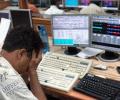
IndusInd Bank was the biggest loser in the Sensex pack, shedding 7.46 per cent, followed by SBI, Tata Motors, M&M, Bajaj Finserv, Axis Bank and Infosys. In contrast, Tech Mahindra was the only winner.

India is now a biz friendly nations, say Arun Jaitley.

Chidambaram said NSEL was not a registered or recognised association under the FMC but got exemption even before it started its business.

While the four largest listed paint companies have seen marginal negative returns, the S&P BSE Fast Moving Consumer Goods (FMCG) and the National Stock Exchange Nifty FMCG indices have delivered a solid 16 per cent return during the same period. Initially, volume growth and reduced costs bolstered the sector's sentiment, but brokerages have grown cautious due to increased competitive pressures.

Foreign share holding limit in Maruti Suzuki India has reached trigger limit and any further investment by FIIs will be allowed only after RBI's approval.

'Markets are not expensive; they are fairly priced.'
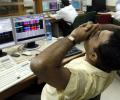
Stock market investors became poorer by Rs 8.30 lakh crore as equities continued their slide for the sixth consecutive day on Friday. The BSE Sensex has tumbled 1,855.58 points or 3 per cent since February 16. During this period, the combined market capitalisation of BSE-listed firms has tanked Rs 8,30,322.61 crore to reach Rs 2,60,00,662.99 crore. "The domestic market is broadly demonstrating a lack of confidence, registering its sixth consecutive day of losses despite global markets turning green.
Stock and other financial markets are likely to resume trading today, after a day, as these were shut in the wake of deadly terrorist attack in Mumbai.

Hindalco's first quarter (Q1FY23) results indicate healthy domestic volumes for aluminium and copper, and lower cost of production. Subsidiary Novelis saw weak volume trends but it managed to push operating profit margins on a better mix and pricing hikes. The weak global outlook on aluminium is a cause for ongoing concern.

The government on Friday proposed hiking the securities transaction tax on Futures & Options (F&O) contracts, a move that will increase the trading costs in the derivatives segment as well as help in curbing excessive trades. In the Finance Bill 2023, passed by the Lok Sabha on Friday, the Securities Transaction Tax (STT) on options is proposed to be increased to 0.0625 per cent from 0.05 per cent and on futures contracts to 0.0125 from 0.01 per cent. Analysts opined that higher STT will shore up the government's revenues to some extent and also discourage excessive trading since a large number of retail traders are losing money in the segment.
Kotak Mahindra Bank was the biggest loser from the Sensex pack, skidding 1.83 per cent, followed by Axis Bank, NTPC, Hindustan Unilever, ICICI Bank, Bharti Airtel, Reliance Industries, HCL Technologies, IndusInd Bank and Nestle. In contrast, Bajaj Finance, Bajaj Finserv, Tech Mahindra, Tata Consultancy Services, Titan, Infosys, HDFC Bank, HDFC and ITC were the gainers.

The rupee on Thursday closed at its all-time low of 78.32 (provisional) against the US dollar as strong American currency and persistent foreign fund outflows weighed on investor sentiments. At the interbank foreign exchange market, the local currency opened at 78.26 and finally settled at its all-time low 78.32, unchanged from its previous close. On Wednesday, the rupee declined by 19 paise to settle at an all-time low level of 78.32 against the US dollar.

The RBI banned imports on a consignment basis, making it difficult for jewellers to source raw material.

Investors' wealth climbed Rs 3.20 lakh crore as markets staged a smart comeback on Wednesday after falling in the last eight trading sessions. The BSE Sensex rallied 448.96 points or 0.76 per cent to settle at 59,411.08. During the day, it jumped 513.33 points or 0.87 per cent to 59,475.45.

Any shift in investor sentiment may result in speculators fleeing the gold market, driving its price down sharply, quickly. One significant risk for gold is a near-term reversal in the dollar, which recently fell to a two-year low.

Among the Sensex firms, Bajaj Finserv, Tata Motors, Asian Paints, ITC, IndusInd Bank, State Bank of India, Tata Steel, Wipro, Infosys and Maruti were the major gainers. Tech Mahindra, HCL Technologies, Kotak Mahindra Bank, Titan and Larsen & Toubro were the major laggards.

Carmakers Mercedes-Benz, Audi, Renault, Kia India and MG Motor on Wednesday announced plans to hike vehicle prices from January to partially offset the impact of rising input costs. They join the likes of market leader Maruti Suzuki India and Tata Motors, which have also made the year-end announcements to raise prices from next month. Audi India said it will increase prices of its entire model range by up to 1.7 per cent, while Mercedes-Benz India noted it will hike the prices by up to 5 per cent from January 1.

The shares - close to 30% of the total holding - are expected to list on rival National Stock Exchange on or around February 3.

While NSE is exploring 8-10 new agri-commodities, BSE is eyeing as many as 15, most of which aren't traded on any other online derivative exchange in India.

The decision to quiz Sinha, as also former Sebi Chairman M Damodaran, was taken after examination of another former Sebi chief C B Bhave earlier this month, during which the agency sleuths were told that public interest was involved in grant of licence to MCX-SX to trade in currency derivatives.

In 2022, gold emerged as the top performer among all conventional asset classes with over 14 per cent returns mainly owing to the depreciation of the rupee.
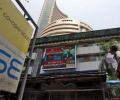
Equity benchmark indices Sensex and Nifty buckled under selling pressure after a nine-session rally on Monday, as massive sell-off in IT, tech and telecom counters unnerved investors.

The rupee depreciated 40 paise to an all-time low of 81.93 against the US dollar in early trade on Wednesday as the strengthening of the American currency and risk-averse sentiment among investors weighed on the local unit. Moreover, a negative trend in domestic equities and significant foreign fund outflows sapped investor appetite, forex traders said. At the interbank foreign exchange, the rupee opened at 81.90 against the greenback, then fell to 81.93, registering a fall of 40 paise over its previous closing.

The central government is on track to meet its fiscal deficit target of 6.4 per cent of the GDP for 2022-23 on the back of strong growth in revenue collections, the World Bank said in its India Development Update on Tuesday. High nominal GDP growth in the first quarter supported strong growth in revenue collection, especially Goods and Services Tax (GST), despite tax cuts on fuel. Notwithstanding an increase in spending due to expanded fertilizer subsidies and food subsidies for vulnerable households in response to the commodity price shock, the government is on track to meet its FY22/23 fiscal deficit target of 6.4 per cent of GDP and the general government deficit is projected to decline to 9.6 per cent from 10.3 per cent in FY21/22 and 13.3 per cent in FY20/21.
 © 2026 Rediff.com - Advertise with us - Disclaimer - Privacy Policy - Sitemap - Feedback - About us - Terms of use - Grievances